Joomla sometimes comes under fire in regards to its usefulness as a blogging platform. The comparisons between Joomla and WordPress abound on the internet, and these comparisons usually generate quite a bit of heated debate. Often this debate, or rather the heat of the debate, is due to the fact that both platforms have such rabid followings. However, there is also the fact that the two are so different. It tends to be an “apples and oranges” comparison.
However, in this article I want to show how Joomla has come into its own in terms of a blogging platform. This is usually where WordPress excels, but there have been some great improvements in tools for blogging with Joomla. A few of them are listed below.
The Joomla! Core
The Joomla core on its own has greatly improved for bloggers. The introduction of nested Categories means storing articles makes a lot more sense, and it’s much easier to manage content in the Administrator back end. When combined with an extension like Komento, which is freely available from StackIdeas, a fully featured basic blogging platform is ready to go.

If you have another preferred commenting system, such as Disqus or LiveFyre, third party extensions make that integration easy. Check the Joomla Extensions Directory for available entries in that category.
The updated and improved ACL (Access Control List) in recent versions of Joomla also help provide varying access to information on a complex blog. The new system is very powerful and provides a lot of flexibility for more advanced users.
EasyBlog
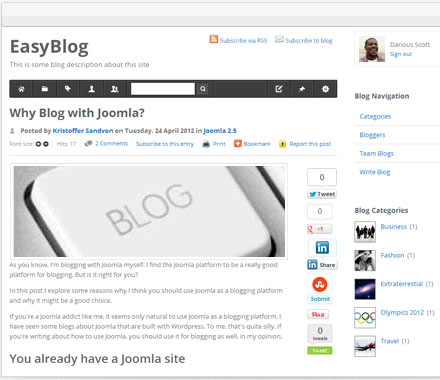
Also by StackIdeas is probably the best “out of the box” blogging platform for Joomla called EasyBlog. As I mentioned, the latest versions of Joomla itself are much more robust for this type of website, but when you add EasyBlog, you also get a full set of blogging features, such as built in comments, advanced media management and lots of integration with social media.
Creating an RSS feed or automatically posting to social networks such as Facebook and Twitter are simple with this application. There’s also direct integration for newsletters and social extensions such as Jomsocial and Community Builder.
EasyBlog is for those looking to get up and running quickly with a powerful blog that has loads of features.
K2
K2 is often used as a blogging platform with Joomla because of its easy customization and its ability to add custom fields. It’s also free. K2 is what’s known as a CCK, or Content Creation Kit. What a CCK allows you to do is create custom content types. If you have a blog that uses specific fields regularly, such as reviews or details about products, a CCK might be exactly what you need.
One good example of this is a blog that features regular reviews of products. Each entry might need an image, a review, a section for sizes or colors, and a section for technical specifications. This is all easy to create in K2. The front end modification is also relatively easy to do within the K2 template structure.

ZOO
Another CCK for Joomla that provides a quick and easy start to a blog, whether simple or complex, is ZOO by YOOtheme. Like K2, you can create custom content types that are suitable for any specific type of blog. One great thing about ZOO is that the no cost “lite” version of the extension provides an out of the box platform for a blog, while the paid version has ready to go setups for movie reviews, a product catalog and more.
Since YOOtheme produces ZOO, almost all of their templates also provide excellent integration for the extension, which provides the functional platform and great looks.

WordPress for Joomla
Since the usual comparison between Joomla and WordPress has already been mentioned here, I might as well include the WordPress for Joomla extension, produced by corePHP. This extension actually integrates WordPress directly into a Joomla installation. As corePHP puts it, “We’ve combined the most popular blogging platform with the most popular CMS to create the most powerful blogging component ever made for Joomla!”
One aspect that makes this interesting for some website owners is that it’s easy to create multiple blogs within one Joomla installation. You can also integrate WordPress plugins and themes while using Joomla content plugins at the same time.
If you’re working with writers who are familiar with WordPress, but you’re running a Joomla blog, this could be a very nice solution.
Joomla Extensions Directory
Of course, there are more choices than those listed here, and you can find them by checking the blog section of the JED.
Did we miss one? What's your preferred way of creating a blog with Joomla? Please comment below.